
Ophthalmology Billing Errors: Why Claims Get Denied & How Clinics Fix Them in 2026

Ophthalmology Billing Errors: Why Claims Get Denied & How Clinics Fix Them
If you run an ophthalmology clinic, you’ve probably faced this:
Claims submitted…
Weeks pass…
And then denied
No clear explanation. No payment. Just delays.
A Complete Guide to Reduce Denials and Improve
Revenue

The truth is, most ophthalmology clinics don’t lose revenue because of lack of patients they lose it because of billing mistakes they don’t even realize they’re making.
Let’s break it down.
The Hidden Problem: Small Errors, Big Revenue Loss
Most billing issues in ophthalmology aren’t big mistakes.
They’re small things like:
- A missing modifier
- Incorrect diagnosis code
- Incomplete documentation
But these “small” issues can delay payments by weeks or even months.
And when they happen repeatedly, clinics start losing serious money.
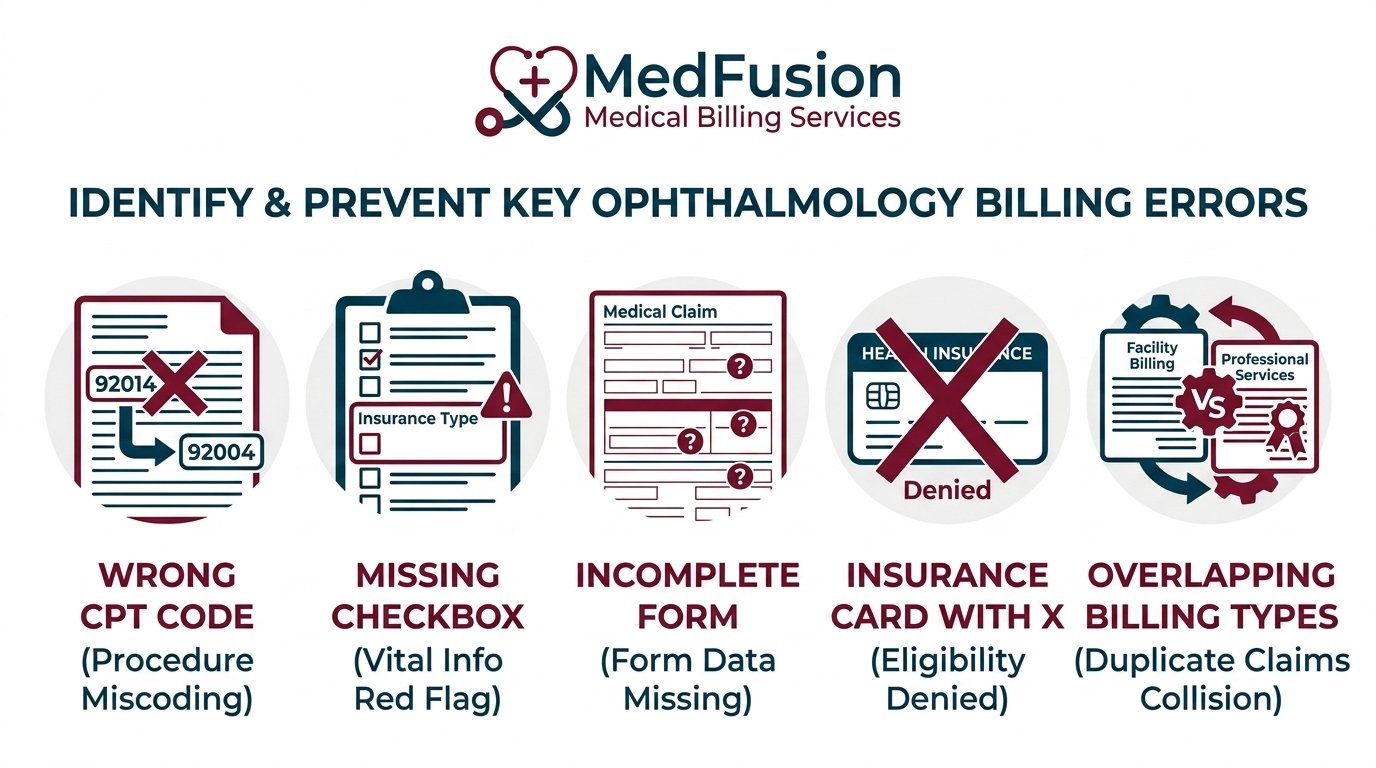
Most Common Ophthalmology Billing Errors
-
Incorrect Use of CPT Codes
Ophthalmology procedures are highly specific. Using a slightly wrong code can lead to rejection.
Example:
Billing a general exam instead of a specialized eye procedure.
-
Missing Modifiers
Modifiers are critical in eye care billing.
Without them, insurers may assume:
Duplicate service
Unnecessary procedure
Result → Claim denied
-
Weak Documentation
If your documentation doesn’t clearly support the procedure, insurance companies won’t approve it.
Even if the treatment was correct.
-
Insurance Eligibility Not Verified
Many clinics skip proper verification.
Result:
- Patient not covered
- Service not included
- Claim rejected
-
Mixing Medical vs Vision Billing
This is a BIG one in ophthalmology.
- Medical billing → disease-based
- Vision billing → routine exams
Confusion here = automatic denial.
Why These Errors Keep Happening
It’s not because clinics don’t care.
It’s because:
- Billing staff is overloaded
- Codes keep changing
- Systems are manual
- No specialist handling eye care billing
In short: the system isn’t optimized

How Smart Clinics Fix These Problems
Clinics that fix billing issues focus on:
✔ Clean Claim Submission
Every claim is checked before submission.
✔ Specialist Coders
Not general billing staff eye care experts
✔ Automation Tools
Reduce manual mistakes.
✔ Regular Audits
Find errors before insurance companies do.
Real Impact of Fixing Billing Errors
When billing is optimized:
- Claim acceptance rate increases
- Payments become faster
- Revenue becomes predictable
- Stress reduces
This is where most clinics see 20–30% improvement in cash flow
Should You Fix It In-House or Outsource?
You have two options:
Option 1: In-House Fix
✔ More control
❌ More cost
❌ Requires training + hiring
Option 2: Outsourcing Billing
✔ Faster implementation
✔ Expert handling
✔ Lower long-term cost
Most growing clinics choose this.
Final Thoughts
Ophthalmology billing isn’t just about submitting claims.
It’s about:
Accuracy
Strategy
Consistency
And if even one part is weak, revenue suffers.
Fixing these small errors can make a massive difference in how your clinic performs financially.

❓ FAQs
- Why do ophthalmology claims get denied so often?
Because of coding errors, missing modifiers, or incorrect billing type (vision vs medical).
- What is the biggest billing mistake in eye care clinics?
Mixing medical and vision billing is one of the most common issues.
- Can small coding errors really affect revenue?
Yes even minor mistakes can delay or completely deny payments.
- How can clinics reduce billing errors quickly?
By using trained coders, verifying insurance, and auditing claims regularly.
- Is outsourcing better than in-house billing?
For most clinics, yes it improves accuracy and reduces workload.
Tired of claim denials slowing down your revenue?
Let our experts review your billing process and show you exactly where you’re losing money.